-
2012-06-07, 10:55 PM
#3761

為了提升訊息量,
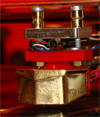
第二系統來加上 clearaudio concerto..
哇...比預期的好太多了..

-
The Following 4 Users Say Thank You to hojuiyang111 For This Useful Post:
-
2012-06-09, 09:35 PM
#3762
 作者: hojuiyang111

正式來試試 biwire
要 run in 幾天吧,
感覺聲音變化不小,
中低音訊息增加很多.
相信可以找到一個更佳的平衡.. 

biwire 會改變系統聲音?
why?
-
-
2012-06-09, 09:42 PM
#3763
來看看有何資料參考?
In a single wired system unwanted mechanical and electrical resonances appear as distortion at both sets of speaker terminals. Due to the impedance of the speaker cables these distortions will not be entirely cancelled by the amplifier. Instead, they modulate between the two crossovers, degrading sound quality. With bi-wiring this interaction is minimised as signal distortion is 'seen' at the amplifier's output where it can be more effectively cancelled. Bi-wiring therefore presents a 'cleaner' signal at both the bass and treble speaker terminals, and because the high and low frequencies have already been separated, each has a minimal effect on the other - the bass does not overpower the delicate treble.
In terms of the audible benefits of bi-wired speakers, Soundstage in 1998 said: "There should be more clarity and detail to the midrange and high frequencies. Often the bass becomes less fat in nature, becoming both a bit faster and tighter. Focus and staging should improve nicely as well. You may notice less congestion in dynamic or complex passages. In all, this is a very effective and desirable improvement and only requires the investment in a second set of speaker cables".
-
The Following User Says Thank You to hojuiyang111 For This Useful Post:
-
2012-06-09, 09:54 PM
#3764
Biwiring works by reducing of the tendency for strong bass signals to overwhelm the rest of the audio signal. The larger, more powerful bass signal can greatly affect the integrity of the much lower-energy components of both the midrange and fragile treble information. Running separate wires from the amplifier can have a profound impact on relieving the tweeter circuit from the back flush of EMF (elector-motive force) generated by the woofer. When the audio signal to the woofer ceases, such as when a loud bass note is finished, the woofer tries to stop moving. In trying to stop, it actually goes through a process of "settling" because it is too massive to just stop instantly. As it settles, it moves forward and backward repeatedly until it can completely come to rest. During this movement, as the voice coil is moving through the field of the magnet, it generatesits own signal. That generated signal is sent backward up the woofer wires and into the crossover, where it corrupts the rest of the music signal.
Biwiring also affords you another grand luxury. Aside from helping to eliminate distortions, it also permits you to select specific wires for each frequency application. If you have been in this hobby/sport/disease for any length of time, you will have at least heard by now that all wires, both loudspeaker and interconnect, possess their own characteristic sound. When biwiring, you have the ability to match a wire that is open and airy, but is perhaps lean in the bass region, to the tweeter. By the same token, some of the best bass performance is delivered from wires that aren’t so revealing or extended in the high frequencies. So hitch up the low-frequency drivers with that wire. Now you’ve got the best of both worlds!
-
The Following User Says Thank You to hojuiyang111 For This Useful Post:
-
2012-06-13, 10:42 PM
#3765
biwire 後會more clarity and detail to the midrange and high frequencies?
我以前的經驗也是如此,
有趣的是,這次的聽感卻不是,
又跌破了一次眼鏡.
-
-
2012-06-15, 06:48 PM
#3766
不小心又買了一台唱放
ASR BASIS EXCLUSIVE

-
The Following 3 Users Say Thank You to hojuiyang111 For This Useful Post:
-
2012-06-15, 06:59 PM
#3767
非常好用的唱放,阻抗及 GAIN 可多段微調
初聽就知道是台十分厲害的機絲

-
The Following 2 Users Say Thank You to hojuiyang111 For This Useful Post:
-
2012-06-16, 10:30 AM
#3768
唱放 的設定就是極有技術和趣味的,
MC 阻抗、容抗、輸出大小,在大多數的唱放均會造成很大的差別,
偶而讀讀 MANUAL ,嘗試作個不同的設定,
有時可以找到更好的聲音.
-
The Following 3 Users Say Thank You to hojuiyang111 For This Useful Post:
-
2012-06-19, 11:02 AM
#3769
值得去一探究境

-
-
2012-06-19, 05:19 PM
#3770
感謝! 看到何大這篇, 才知道有人將曹先生文集整理出書....當然趕快下定. 今天收到書了.
曹先生之前的文章是我必看的, 而且從中學習太多了.
應該辦個團購才是.
-
The Following 2 Users Say Thank You to River For This Useful Post:
 發文規則
發文規則
- 您不可以發表新主題
- 您不可以發表回覆
- 您不可以上傳附件
- 您不可以編輯自己的文章
-
討論區規則
|



 回覆時引用此篇文章